A Silver Jewellery Box, Arranged for a Quiet Morning
Arrange a silver jewellery box so delicate pieces stay separate, pairs are easy to find, and worn jewellery has a clear place to return.
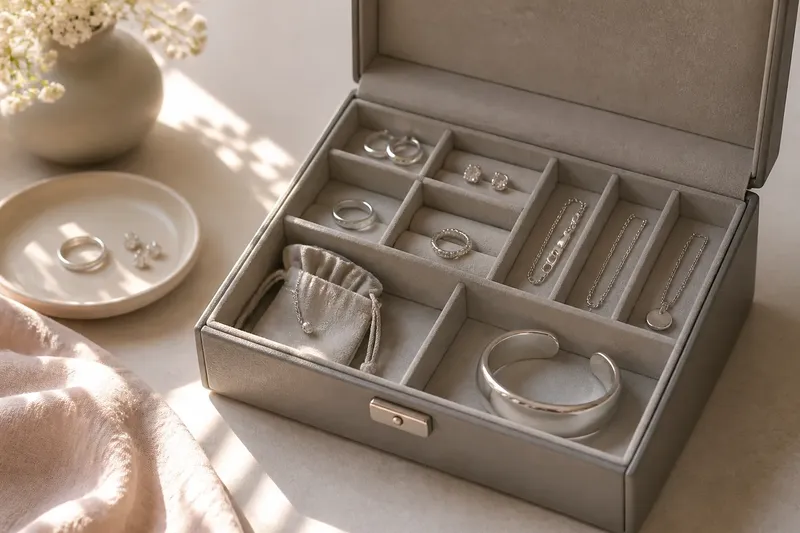
Where is the small silver hoop you meant to wear today? A silver jewellery box arranged for a quiet morning makes that answer easy: delicate forms have their own space, pairs stay together, and there is room to put each piece back without untangling a knot.
The aim is not to display a large collection or create a perfect system. It is to make a few familiar choices visible and easy to handle while you are getting ready. Think of the box like a drawer with dividers: each section gives an object a sensible place, without making the whole arrangement rigid.
Start with the morning routine
Begin with the pieces you actually reach for before leaving home. Set out a small group on a clean, soft cloth, then notice which forms tend to be worn together: perhaps a pair of silver studs, a fine chain, and a ring. This is a practical starting point, not a rule about how much jewellery belongs in the box.
Keep the everyday group near the front or at the top. If the box has a lid that opens toward you, use its easiest-to-reach area for these pieces. Less frequently worn items can sit farther back, provided they remain visible enough to retrieve without moving a stack of jewellery.
Now consider the order in which you put things on. If you usually choose earrings first, let the earring section be easiest to reach. If a pendant is the piece that completes your outfit, give its chain a place where it can be lifted without catching on other items. A layout that follows your routine is more useful than one arranged by metal color or size alone.
Separate delicate forms
Chains, hooks, and fine wire shapes can catch on one another. Give each fine chain its own channel, pouch, or shallow compartment. Lay it down loosely rather than winding it tightly around a post; the goal is to keep it contained and easy to pick up, not stretched or compressed.
Use divided sections for small earrings and rings, and place heavier or more sculptural pieces where they cannot press against delicate ones. A broad cuff, for example, needs more room than a pair of small studs. If the box has a soft lining, check that it is clean and intact, especially where a clasp or sharp post may meet the surface.
Soft pouches can help when a box lacks built-in dividers. Choose pouches that let you distinguish their contents by touch or appearance, and avoid putting multiple fine chains together in one bag. A pouch should solve a storage problem, not hide a tangle until the next morning.
Say you wear a fine pendant chain with small hoops on workdays, and the chain often catches on the hoops in a shared compartment. Imagine placing the hoops in a divided tray and laying the chain alone in a narrow pouch beside it. The next time you open the box, the pair is visible and the chain can be lifted without pulling another piece along.
Keep pairs easy to find
Pairs are easiest to locate when each pair has one shared home. Use a small divided compartment, an earring card, or a soft pocket that keeps both pieces together. For earrings with backs, store the backs with their pair so you do not have to search elsewhere before wearing them.
Posts can be secured through an earring card, while hooks may rest in a section where their curves do not snag fabric or other jewellery. If a pair has different shapes, place them in the same compartment in the way you recognize as a set. The arrangement should make the relationship obvious at a glance.
Do not let an empty compartment become a reason to crowd pairs together. A little open space makes it easier to lift one earring without disturbing the next. It also gives you a place to set down a piece briefly while choosing what to wear.
Leave a return place
A jewellery box needs space not only for pieces in storage, but for pieces coming back from wear. Reserve a small, open area for the item you have just removed. This temporary landing place keeps a ring or pair of earrings from being dropped on a dresser and forgotten there.
Make the return spot distinct from the sections for clean, stored pieces. It might be a shallow dish beside the box or an empty compartment near the front. The useful feature is not its shape but its visibility: you should notice that something is waiting to be put away.
After wearing a piece, follow the care guidance appropriate to its materials and finish before returning it to storage. Do not assume every silver piece should be cleaned in the same way; details such as attached stones, coatings, or manufacturer instructions can change what is suitable. When the right care is unclear, check the maker’s guidance or ask a qualified jeweller.
Choose a box that fits
The box should suit the forms you own, rather than the other way around. A shallow tray with dividers can work well for small earrings and rings. A box with longer channels may better accommodate chains, while a larger compartment can give cuffs or statement pieces breathing room.
Look for sections that open without forcing you to lift several layers just to reach everyday jewellery. A lid that keeps dust away can be useful, but an interior that is too crowded can make pieces harder to return. If the box has removable trays, use them to separate daily choices from occasional pieces rather than stacking loose jewellery in the bottom.
Materials and construction matter at the points where jewellery touches the box. A smooth, clean lining helps avoid snagging, while secure hinges and closures keep the compartments in place during ordinary handling. Follow the box maker’s care instructions, and avoid adding unfamiliar liners or treatments that could contact the jewellery without checking their suitability.
Questions about arrangement?
Should silver jewellery be stored together?
Separate pieces that can tangle, scratch, or press against one another, especially fine chains and delicate forms. Divided compartments or individual pouches make it easier to retrieve one piece without disturbing the rest.
Where should I keep earrings?
Give each pair a shared compartment, card, or pocket, and keep any backs with that pair. Place the section where you can see it before moving other jewellery.
What if my box is too small?
Keep the pieces you wear most often in the accessible space, and store less-used pieces separately in a suitable, clean container. Do not force a lid closed over crowded jewellery, since pressure can tangle or deform delicate forms.
Should I arrange jewellery by color?
Arrange it by the way you choose and wear it first. Grouping by routine or form usually makes pairs and everyday combinations easier to find; color can help within those groups if it is useful to you.
Keep the layout flexible
A good arrangement can change as your habits change. If you find yourself reaching past the same piece each morning, move it closer to the front. If a compartment repeatedly catches a chain, give that chain a separate place. These small adjustments keep the box useful without turning tidying into a project.
For a silver jewellery box, the most helpful layout is the one that makes choosing, handling, and returning pieces feel straightforward. Keep delicate forms apart, keep pairs together, and leave one visible place for jewellery after wear. That modest bit of open space is what lets the box serve the next quiet morning as well as this one.