Polished, Brushed or Matte: Reading Three Silver Surfaces
Compare polished, brushed, and matte silver finishes by their light, texture, and visual character to choose a surface that suits your style.
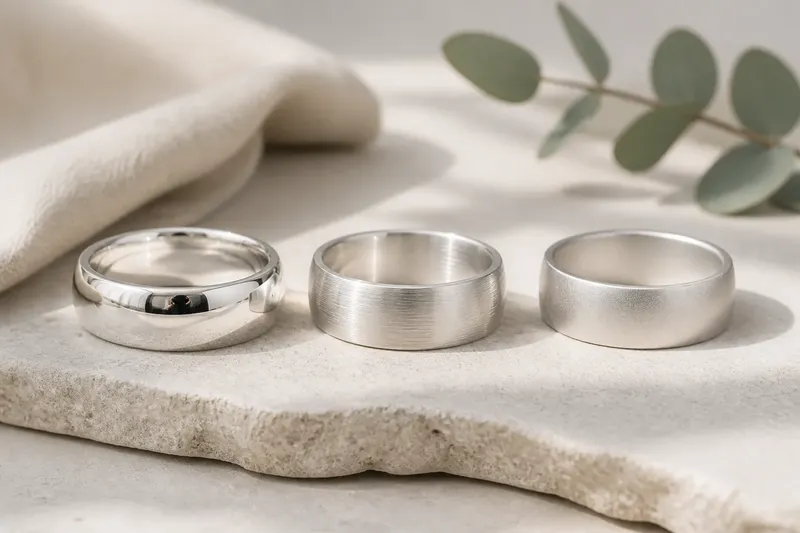
Which silver finish gives a piece the look you want? Polished, brushed, and matte silver can share the same metal and shape, yet each handles light differently. Read the surface as part of the design: its reflection, visible texture, and relationship to nearby details can make the same ring feel crisp, understated, or softly tactile.
Three silver surfaces
- Polished silver reflects its surroundings. A polished surface is smooth and reflective, so it catches bright highlights and may show nearby colors or shapes. The shine can sharpen the outline of a pendant or make a simple band feel more formal. It is a good fit if you like a clear gleam and want the surface to draw attention.
Look at the piece under more than one kind of light. A polished ring can appear almost mirror-like beneath a shop spotlight, then read as a softer shine in a room with diffused daylight. Small marks may also be easier to notice because they interrupt the reflection. That visible change is part of the finish’s character, not a sign that every polished piece is alike.
- Brushed silver shows directional texture. Brushing leaves fine, usually parallel lines across the metal. The surface still catches light, but the reflection breaks into a subdued sheen rather than a crisp image. The line direction can be part of the design: strokes running around a cuff emphasize its curve, while strokes across a pendant create a more graphic plane.
Inspect the texture from several angles. Brushed lines are often easiest to see when light falls across them, and they may appear less distinct when viewed head-on. This finish suits someone who wants a visible surface character without the strong reflection of a mirror polish. It can also sit comfortably beside a polished edge, where the contrast makes each treatment legible.
- Matte silver diffuses light. “Matte” describes a low-reflection appearance, not one exact texture. A matte surface may look finely even, softly granular, or subtly stippled, depending on how it was finished. Its quiet appearance can let the silhouette, stone, or overall form carry more of the design’s attention.
Check for texture rather than assuming all matte silver feels the same. Some surfaces look velvety but feel nearly smooth; others have a more noticeable grain. Imagine choosing between two silver studs with the same shape: one has a bright polished face, the other a softly matte face. If you want the outline to stand out without a strong flash of light, the matte version may suit that preference.
Reading silver finishes?
How can you tell brushed silver from matte silver?
Look for direction. Brushed silver usually has fine lines that run in a discernible direction, while matte silver tends to diffuse light without an obvious set of strokes. A close view under angled light can make that distinction easier.
Does polished silver always look mirror-bright?
No. The degree of polish and the surrounding light affect how reflective it appears. A polished curve may give a lively highlight without reflecting a sharp image like a flat mirror.
Can one piece combine different finishes?
Yes. A maker can pair a polished rim with a brushed or matte center, using the change in reflection to outline a form or draw attention to a detail. The finish boundary may be subtle or intentionally graphic.
Choosing a surface
Start with the visual mood you want, then consider how the finish relates to the piece’s shape and details. A simple analogy helps: a polished surface is like a clear window that reflects what is around it, while a brushed surface breaks that reflection into lines and a matte one softens it. None is inherently more refined; each gives the design a different voice.
- Choose polished if you enjoy bright highlights, crisp reflections, or a more noticeable gleam.
- Choose brushed if directional lines and a restrained sheen appeal to you.
- Choose matte if you prefer soft light and a surface that does not call attention through reflection.
- Compare neighboring details if the piece mixes finishes; ask whether the contrast defines an edge or distracts from the form.
- View the item in ordinary light as well as display lighting, so you can judge its everyday appearance rather than relying on a single bright reflection.
These are preferences, not rules. A polished finish can look quiet on a small, rounded form, and a matte finish can feel bold when it covers a broad, sculptural shape. Brushing can be delicate or graphic depending on the direction and visibility of its lines. Consider the whole piece instead of deciding from the finish name alone.
When finishes meet
Mixed surfaces can make small design decisions easier to read. A polished border around a matte face, for example, can separate the center from the outline without changing the piece’s shape. On a ring, a brushed band paired with a polished detail may create contrast that is visible in a glance. The practical question is whether the finishes support the form you like, not whether the combination follows a fixed convention.
Product descriptions sometimes use “satin,” “brushed,” and “matte” in overlapping ways. If the exact surface matters to your choice, inspect clear close-up images or ask the seller how the finish looks and feels; the label and maker’s description are the best guide for that particular piece.
When comparing silver finishes, the useful search is not for a universally best surface, but for the one whose reflection and texture fit your taste. Notice how the light moves across the piece, then decide whether you want a bright reflection, directional grain, or a softened glow. That small visual distinction can help you choose a piece you will be glad to wear.