What Sterling Silver Means, and What It Does Not
Learn what sterling silver means and how to distinguish its alloy from plating, finishes, and other components before deciding what a jewelry listing tells you.
What does sterling silver mean on a ring or chain listing? Sterling silver describes an alloy, not every detail of a finished piece. Knowing that boundary helps you distinguish the metal claim from plating, design, and other materials.
Sterling silver basics
An alloy is a material made by combining metals. Sterling silver is the standard commonly described as 92.5% silver and 7.5% other metals; copper is often used. The mark “925” refers to that silver content.
Fine silver, sometimes called pure silver, has a higher silver content and is commonly marked “999.” These labels describe different alloy compositions, not a simple ranking of quality. A silversmith may choose sterling for a wearable form that benefits from an alloy’s firmer character.
Think of the alloy like a recipe: knowing one ingredient does not tell you how the finished dish was shaped or served. “Sterling silver” identifies an important material detail, but it does not describe the whole piece.
Read silver claims
Read the full listing or tag, not just the largest words on a display card. “Sterling silver” and “925 silver” generally refer to the same standard. “Silver-tone” and “silver-colored” describe appearance; “silver-plated” means a silver layer covers a different base material. None of those terms alone says that an item is sterling throughout.
A description such as “sterling silver with a plated finish” may refer to separate features: the underlying alloy and a layer applied to its surface. Check which parts each phrase describes. A sterling chain might be paired with a pendant made from another material, or sterling posts might be attached to earrings with different components.
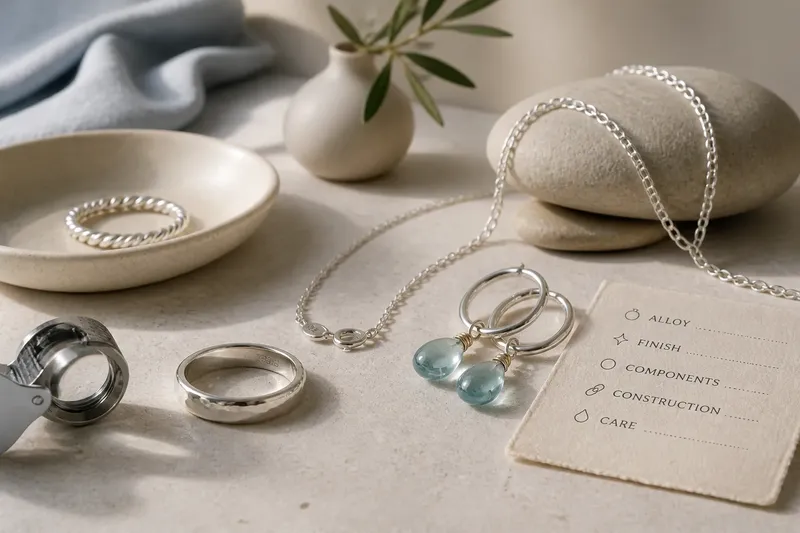
Say you are considering hoops described as “925 sterling silver with gold plating and glass drops.” The stated details identify the hoops as sterling, a gold-colored plated surface, and glass drops. If the metal used for the connections matters to you, ask the seller whether those parts are also sterling before deciding whether the description meets your needs.
Inspect marks carefully
A small “925” or “Sterling” stamp can support a description. It may be on a ring band, chain clasp, or earring post. A mark can be difficult to see on a small item, and its presence does not explain every component or the item’s history.
Use a jeweler’s loupe or a phone camera with close focus to inspect a mark in good light. Do not scrape, file, or apply chemicals to identify the metal; those actions can damage a surface and are not dependable ways to assess a finished piece.
If an item is valuable, inherited, or disputed, ask a qualified jeweler or appraiser to assess it and explain what the assessment can establish. For a routine purchase, a clear maker’s description and return policy may be more useful than interpreting a faint stamp by itself.
Separate alloy and design
The alloy label does not say whether a piece is solid or hollow, cast or formed from sheet, or assembled from several components. It does not describe a chain’s link construction or tell you whether a ring is delicate or substantial. Those are design and construction details.
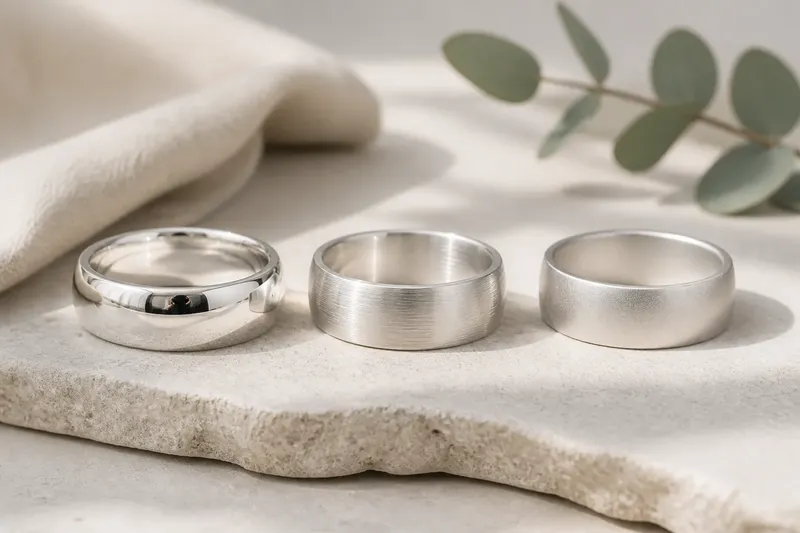
Sterling silver also does not specify the surface treatment. A sterling item may have a bright, darkened, colored, or coated surface. The label does not establish whether a stone is natural, whether a clasp is sterling, or whether each soldered joint uses the same alloy. Look for separate descriptions of finishes, stones, and mixed materials.
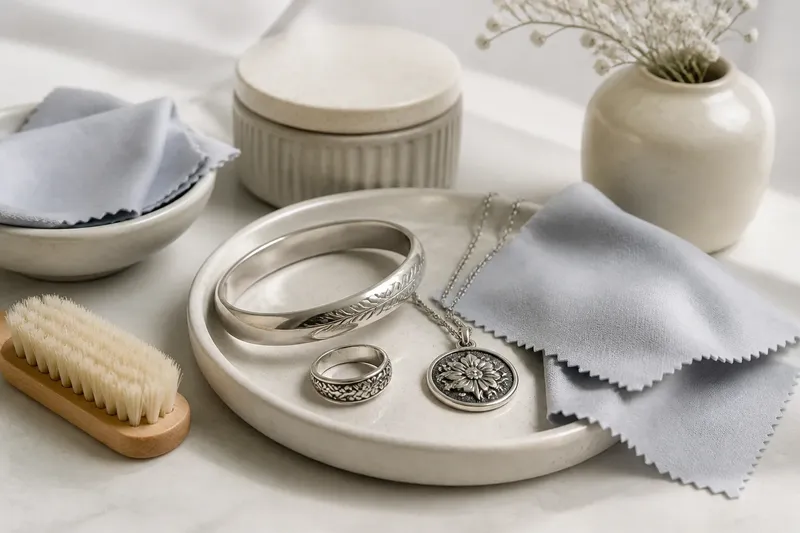
Care depends on more than the alloy. Sterling can tarnish, while a coating or attached stone may affect which cleaning method is suitable. Follow the maker’s care directions, particularly for pieces with stones, coatings, or delicate components.
Listing details to check
Use each observation to decide what to ask next. If the listing leaves a detail unclear, do not treat that silence as proof of a particular material or construction.
- Metal wording: If it says “sterling” or “925,” treat that as an alloy claim; if it says only “silver-tone,” ask what the base material is.
- Claim coverage: If the wording names specific parts, treat the claim as limited to those parts; if it does not, ask which components it covers.
- Surface treatment: If plating or coating is named, check which areas are covered; if none is mentioned but the appearance matters, ask whether the surface has a treatment.
- Other materials: If stones, beads, or mixed metals are listed, check which components they describe; if a material is missing, ask before relying on an assumption.
- Construction: If the listing says solid, hollow, or assembled, use that description to compare designs; if construction matters but is unstated, ask the seller.
- Care directions: If the maker gives instructions for the finish and attached materials, follow those directions; if not, ask before using a polishing cloth or cleaner.
These checks help you compare descriptions on the same terms. A brief listing does not by itself prove a piece is misdescribed, but it leaves more questions open. Ask one focused question about the detail that matters to you.
Questions about sterling silver?
Is sterling silver real silver?
Yes. Sterling silver is an alloy with a high silver content and other metal in its composition. It is not the same as fine silver, and the term does not mean the item is silver-plated.
Does 925 mean pure silver?
No. “925” describes the sterling standard: 92.5% silver, with the remainder made up of other metals. Fine silver is commonly marked “999,” a different fineness description.
Does a 925 stamp prove every part is sterling?
Not necessarily. A mark may identify the standard of a component or piece, while stones, clasps, coatings, and other parts may be described separately. Check the listing or ask which components the mark covers.
Can sterling silver tarnish?
Yes. Sterling can darken or change appearance through tarnish, which alone does not establish that an item is fake. Follow care instructions suited to its surface and attached materials.
Use the label precisely
When a listing says “sterling silver,” read it as an alloy description. It distinguishes that material from fine silver and from a silver-colored or plated surface, but it does not settle questions about construction, finish, components, or care. For sterling silver, the useful next move is to identify which of those unanswered details matters to you and ask about that specific part.